

Is Morocco Affected by the Middle East Conflict? 2026 Update
How the Middle East conflict affects Morocco: fuel prices, the economy, tourism and your trip
- Home
- Morocco and the Middle East Conflict
Is Morocco Affected by the Middle East Conflict? The Short Answer
Yes, but indirectly. Morocco is not a party to the Middle East conflict, and it lies thousands of kilometers from the conflict zone. Daily life in Marrakech, Fes, Casablanca and Essaouira continues as normal.
Since the United States and Israel launched strikes on Iran on 28 February 2026, the war has dominated global headlines. A short ceasefire in April raised hopes. However, fighting resumed in July, and tensions around the Strait of Hormuz continue into the autumn.
For Morocco, the effects are economic rather than security-related. In other words, the war reaches the country mainly through energy prices. Below is a clear look at what has changed, and what has not.
Quick answer
- Main impact: higher fuel prices, because Morocco imports almost all its energy.
- Government response: 20 billion dirhams added to the 2026 budget to keep gas, transport and electricity prices stable.
- Economy: still growing faster than most of the region, according to the IMF.
- Tourism: record numbers, with 14.1 million visitors by the end of August 2026.
- For travelers: Morocco remains open and welcoming as usual.
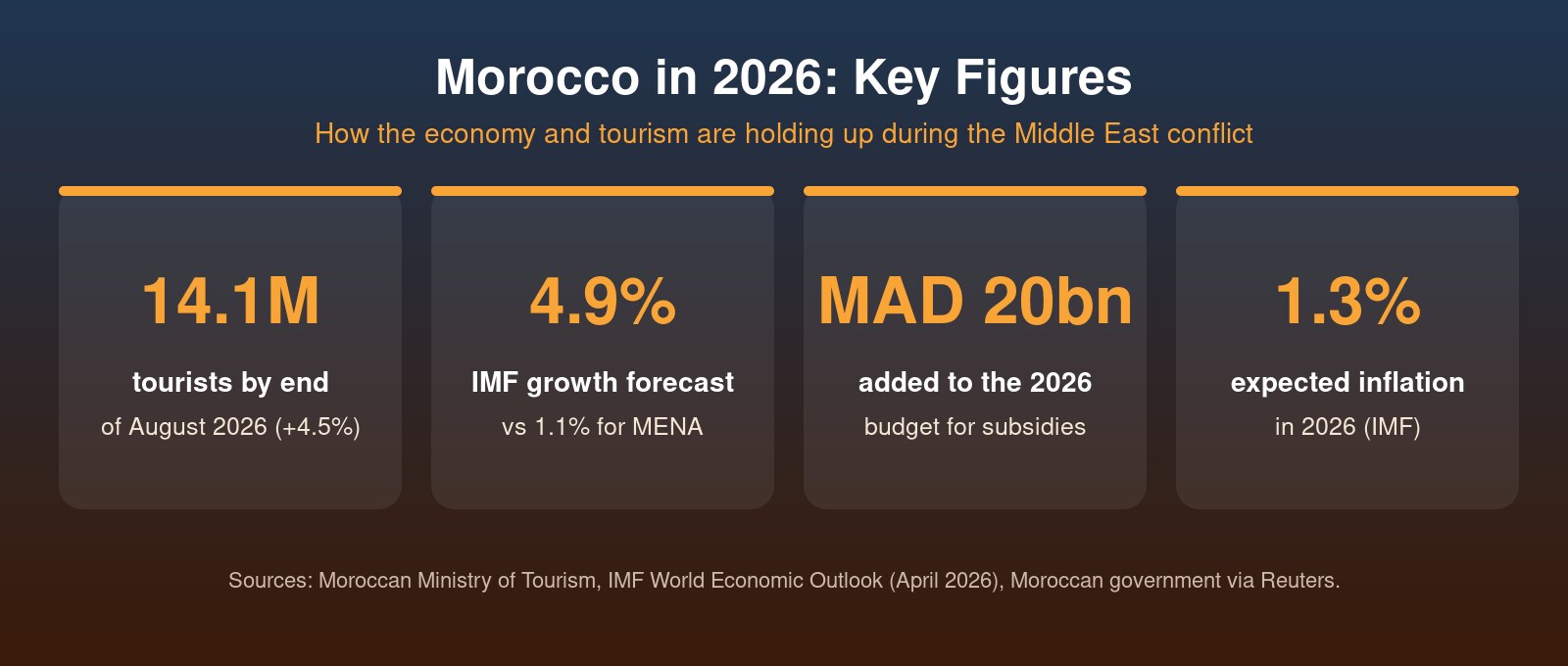
Morocco in 2026: The Key Figures
These figures show how the Middle East conflict has affected Morocco so far. As you can see, the pressure is real, but the economy and tourism are holding up well.
| Tourists by end of August 2026 | 14.1 million, up 4.5% (Ministry of Tourism) |
| Growth forecast for 2026 | 4.9%, compared with 1.1% for the MENA region (IMF) |
| Expected inflation in 2026 | About 1.3% (IMF) |
| Extra budget for subsidies | 20 billion dirhams, about 2 billion US dollars (Reuters) |
| Main channel of impact | Energy imports and fuel prices |
Why a Distant War Still Reaches Morocco: Energy
The main link between Morocco and the Middle East conflict is energy. Morocco imports almost all of the oil, gas and coal it uses. Moreover, it has no domestic oil refinery. As a result, when global oil markets are shaken, Moroccan prices follow.
In March 2026, as the war escalated, crude oil climbed above 100 dollars a barrel. At the time, Moroccan authorities reassured citizens that the country held fuel reserves covering around 30 days of national needs.
Since the 2015 liberalization, fuel prices in Morocco are set by the market. In practice, pump prices follow international prices, and distributors adjust them every two weeks.
The result has been a rollercoaster. First, prices rose sharply in March. Then they eased in June and early July, when the ceasefire calmed markets. Finally, they rose again once fighting resumed. By early September, diesel had passed 15 dirhams per liter in some cities. Industry representatives even warned it could exceed 18 dirhams if international prices keep rising.
For Moroccan households, this is the most visible effect of the war: higher transport costs, and pressure on the price of goods that depend on transport.
How the Moroccan Government Responded
To protect households from the effects of the Middle East conflict, the Moroccan government announced in May 2026 that it would add 20 billion dirhams (around 2 billion US dollars) to the 2026 budget, as reported by Reuters. The money funds subsidies that keep the prices of cooking gas (butane), public transport and electricity stable. In addition, road transport professionals have received several rounds of fuel aid. Part of the package also covers the floods that hit northern Morocco last winter.
In other words, the state has chosen to absorb a large part of the shock itself, rather than pass it fully to consumers. This keeps everyday life stable. However, it also puts more pressure on public finances, a trade-off that economists are watching closely.
The Wider Economy: Pressure, but Resilience
Despite these costs, Morocco has held up better than most of the region. In its April 2026 outlook, the International Monetary Fund projected Moroccan growth of 4.9% for 2026. By comparison, it expects just 1.1% for the Middle East and North Africa region as a whole. Inflation in Morocco should also stay relatively low, at around 1.3%.
One reason is the weather. Abundant rainfall in 2025–2026 ended seven years of drought and boosted agriculture, which offsets part of the external shock. The government itself has forecast growth of over 5% this year.
There are still weak points, though. Morocco’s borrowing costs rose as global markets reacted to the war, and the current account deficit is expected to widen. Moreover, the High Commission for Planning (HCP) has noted weaker demand for phosphate rock, one of the country’s key exports. Overall, external pressure on Morocco’s economy has increased in 2026, even as the domestic picture has improved.
Tourism in Morocco Keeps Breaking Records
For anyone planning a trip, this is perhaps the most important point: despite the Middle East conflict, tourism in Morocco has not slowed down. In fact, it has kept growing.
Morocco welcomed 14.1 million tourists by the end of August 2026, a 4.5% increase on the same period of 2025. August alone passed 2 million visitors for the first time in the country’s history. Meanwhile, tourism revenues reached around 97.9 billion dirhams by the end of August. As a result, Morocco is on track for its target of about 21 million visitors this year, after a record 19.8 million in 2025.
Why Morocco is doing so well
- Stability and distance. Morocco is widely seen as a stable, safe destination far from the conflict zone. Some travelers who would normally visit the Eastern Mediterranean or the Gulf have chosen Morocco instead.
- Proximity to Europe. France and Spain remain Morocco’s largest markets. Flights from Europe are short and direct, and they do not cross Middle Eastern airspace.
- Growing new markets. Arrivals from the United States, Canada and China have also continued to grow.
That said, the war has not been entirely without effect. Higher jet fuel costs have led some airlines to cut routes. Travel through the big Gulf hubs, such as Dubai and Doha, has been disrupted. Gulf visitors, an important market for some Moroccan hotels, have also been fewer. Growth has therefore been steadier than the very fast surges of previous years. Still, the overall trend is clearly positive.
What This Means If You Are Planning a Trip to Morocco
If you are thinking about visiting Morocco in the coming months, here is what the Middle East conflict means for your trip in practice:
Daily life is normal
Medinas, souks, desert camps, mountain villages and beaches are open and welcoming visitors as usual. After all, the conflict is thousands of kilometers away.
Book flights wisely
If you fly from Asia, Australia or elsewhere, a connection through a European hub may be more reliable than one through the Gulf. Travelers from Europe and North America can fly direct or via European cities. See getting to Morocco.
Expect some price movement
Fuel costs can affect transport prices. For this reason, booking your tour or private driver in advance at a fixed price protects you from surprises.
Check official advice
As with any trip, check your own government’s travel advice before departure. Also keep an eye on airline updates if your route passes near the Middle East.
Conclusion
So, is Morocco affected by the Middle East conflict? Yes, but mainly in one area: the cost of energy. Higher fuel prices have pushed up transport costs and forced the government to spend billions of dirhams on subsidies.
Yet the Moroccan economy is still growing faster than almost any other in the region, and tourism has continued to break records. For travelers, Morocco remains what it has long been: a stable, welcoming country, and one of the most rewarding destinations between Europe and Africa.
Is Morocco Safe to Visit?
Wondering about safety in Morocco in general, beyond the Middle East conflict? Our guide gives the short answer, backed by real numbers. For more detail, including tips for solo female travelers, families and emergency numbers, read our full Morocco safety guide.
Frequently Asked Questions
Is Morocco affected by the Middle East conflict?
Yes, but indirectly. Morocco is not a party to the war. The main impact is economic: because Morocco imports almost all its energy, higher oil prices have raised fuel and transport costs. Daily life and tourism continue as normal.
Is it safe to travel to Morocco in 2026?
Morocco is widely seen as a stable and safe destination, far from the conflict zone, and tourism has reached record levels in 2026. As with any trip, check your own government’s travel advice before you go. Read our guide: Is Morocco safe to visit?
Has the war made Morocco more expensive for tourists?
Fuel prices have risen, which can affect transport costs. However, the government subsidizes cooking gas, public transport and electricity. For a private tour, booking in advance at a fixed price protects you from price changes.
Are flights to Morocco affected by the conflict?
Flights from Europe are short and direct, and they do not cross Middle Eastern airspace. In contrast, connections through Gulf hubs such as Dubai and Doha have been disrupted. If you fly from Asia or Australia, a connection through Europe may be more reliable.
How has tourism in Morocco performed in 2026?
Very well. Morocco welcomed 14.1 million tourists by the end of August 2026, up 4.5% on 2025, and August passed 2 million visitors for the first time.
Plan Your Morocco Trip with Confidence
Every one of our tours is private, with a fixed price agreed in advance and a trusted driver-guide by your side. That way, you can relax and enjoy the journey.
Email: travelstomorocco@gmail.com | Phone: +212 6 62 38 50 95